The Hands on the Desk: A Love Letter to the Crew Who Mix, Haul and Hustle Britain's Soul Nights
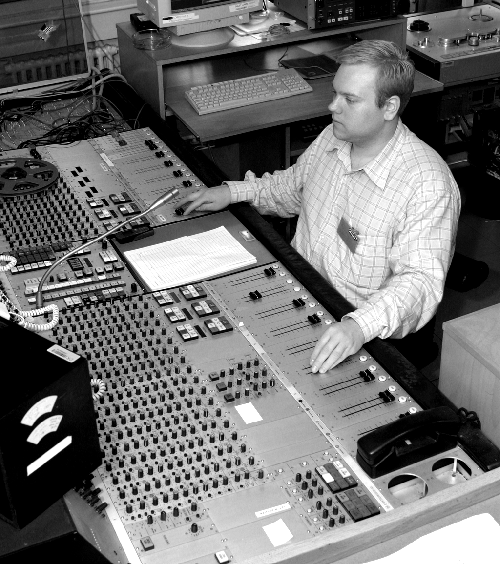
Photo: Unknown, CC BY-SA 3.0, via Wikimedia Commons
There's a moment at every gig that nobody photographs. It happens about forty minutes before doors, when the support act's drummer is still finding his sticks and the room smells of tonight's curry and last night's beer. Somewhere at the back of the stage, a woman in a fleece is coiling cable with one hand and taping a cable run with the other, and she has been here since half nine in the morning. Her name will not appear anywhere tonight. She is, in a very real sense, the show.
The Person Behind the Faders
We'll call her Denise, because that's her name, and because she laughed when we asked if we could use it. Denise has mixed soul gigs in Britain for twenty-two years — Manchester, Glasgow, a memorable run of London shows where the monitor desk lived in what she describes as 'a cupboard with opinions'. She's worked with half the artists you'd find on a UK soul playlist and most of the ones you wouldn't.
'The job is ninety per cent listening and ten per cent arguing,' she told us, nursing a builder's tea between soundchecks. 'Arguing with the drummer about his monitor level. Arguing with the promoter about the curfew. Arguing with the ceiling, sometimes, when the room's having one of its nights.'
What struck us, watching her work a full production rehearsal with a seven-piece soul band, was the vocabulary. Horns don't get 'louder' — they get 'fatter' or 'ruder'. A vocal sits 'in the pocket' or it doesn't, and if it doesn't, Denise will know which of four possible reasons is to blame before the singer finishes the phrase. This is craft. Nobody outside the room ever claps for it.
The Promoter Gambling on a Tuesday
Three hundred miles south, in a basement venue that holds 180 people if you're friendly about it, a man named Kofi is doing something with a spreadsheet that would make an accountant weep. Kofi promotes soul and neo-soul nights in a city that is, by his own admission, 'not exactly Detroit'. Tonight's show is on a Tuesday. The support act is travelling from Leeds. The headline act — a wonderful singer you've definitely heard on a playlist somewhere — is drawing what the industry calls a soft number.
'I've staked my rent on this,' he says, entirely without drama. 'That's the deal. That's always been the deal. You book the artist because the music deserves a room, and then you spend three weeks persuading a city that it agrees with you.'
Kofi's tools are unglamorous: a mailing list he's built one person at a time, a relationship with the venue manager built on eleven years of not letting each other down, and an instinct for which flyer font will stop a scroll. If tonight works, he pays five people and keeps a margin roughly the size of a nice dinner. If it doesn't, he doesn't. 'People think a promoter's the villain of the piece,' he shrugs. 'I'm the only person in this building who loses money if it goes badly.'
1am, and the Real Work Begins
By the time the last encore fades, most of the audience is on the night bus. The crew is just getting started. Loading out a mid-sized soul show — backline, PA, monitor rig, the horn section's borrowed amps — takes ninety minutes of the least photographed labour in British music.
We watched a stagehand named Rhys dismantle a drum riser with the fluid economy of a man who could do it asleep, and who possibly has. He's been crewing for eight years. His knees have opinions about it. 'You're the first in and the last out,' he says, 'and the only time anyone notices you is when something's wrong. Which, if you're good, is never.'
There's a pride in that, he insists. A code. The load-out at 1am, the van packed by half one, the motorway services at two — this is the liturgy of the British live scene, repeated nightly in cities from Southampton to Dundee by people whose reward is a nod from the artist and the knowledge that the show happened.
Why It Matters
Here's the thing we kept coming back to across a week of hanging around venues: the independent soul scene in this country is not held together by record labels, streaming algorithms or viral moments. It's held together by maybe a few hundred Denises, Kofis and Rhyses, most of whom could earn more doing something else and choose not to, because the music matters to them in a way that resists economics.
So the next time you're at a gig and the vocal sounds like it's sitting in your lap, or the night somehow starts on time, or the room feels warmer than the weather outside — spare a thought for the names that never made the poster. Better yet, learn one of them. Buy the engineer a tea. Thank the promoter by coming back next month. The stage lights find the singer. The rest of us should find the crew.